
Kannada
Language
Get a Free Quote Today!
Make an Appointment Today
Kannada Language
A Language of History, Literature, Expression and Living Culture
Introduction
Kannada is a classical Dravidian language spoken by over 56 million people worldwide. Recognized as one of the oldest languages in India with an unbroken literary history spanning over two millennia, Kannada serves as the emotional and cultural soul of the region.
Language with Deep Roots
Kannada has a remarkably long written and literary tradition. One of its earliest major literary works, Kavirajamarga, dates to the 9th century and demonstrates that Kannada already possessed a sophisticated literary tradition at that time.
Over the centuries, Kannada literature evolved through many remarkable periods — from classical poetry and Jain literature to Vachana Sahitya, Bhakti poetry, modern literature, theatre and contemporary writing.
Kannada was officially recognised as a Classical Language of India in 2008, acknowledging its ancient origins, rich literary heritage and independent tradition.
Unique Script
The Kannada script is visually distinctive and belongs to the Brahmic family of writing systems.
Its rounded appearance developed partly because early writing was done on palm leaves. Sharp straight cuts could damage the leaves, encouraging the use of smoother, curved forms.
Kannada script is also closely related historically to the Telugu script, sharing roots in earlier southern Indian scripts.
Today, the script is used not only for Kannada but also, in various contexts, for representing languages and sounds beyond everyday Kannada.
The Beauty of Kannada Grammar
Kannada grammar has its own fascinating structure.
Like many Dravidian languages, Kannada is largely agglutinative — meaning grammatical information can be added to words through suffixes.
A single word can therefore carry information that might require several words in English.
Kannada also generally follows a Subject–Object–Verb (SOV) sentence structure.
For example:
ನಾನು ಕನ್ನಡ ಮಾತನಾಡುತ್ತೇನೆ.
Nānu Kannada māṭanāḍuttēne.
I Kannada speak.
Kannadigaru live, work and study across India and around the world — from Bengaluru, Mumbai and Hyderabad to Dubai, London, Singapore, Sydney, Toronto and the United States.
Some left Karnataka for education.
Some for careers and business.
Some followed their families.
Some built new lives thousands of kilometres away.
But many carry something from home with them:
"ಊರು ಬದಲಾದರೂ, ಬೇರು ಬದಲಾಗುವುದಿಲ್ಲ."
The place may change, but the roots remain.
Linguistic Uniqueness & Structure
-
Phonetic Precision: Kannada's script is fully phonetic—words are written exactly as they are pronounced, leaving no ambiguity in reading or spoken rhythm.
-
Agglutinative Grammar: Features a logical, rule-based grammatical system where prepositions, tenses, and modifiers are attached directly as suffixes to root words.
-
Dravidian Script Dynamics: Famous for its aesthetic, curved character design (Aksharamale), the script includes 49 foundational letters divided into vowels (Swaragalu), consonants (Vyanjanagalu), and combined sounds (Yogavahakagalu).
-
SOV Word Order: Follows a natural Subject–Object–Verb sentence structure, allowing for flexible phrasing while preserving clear syntax.
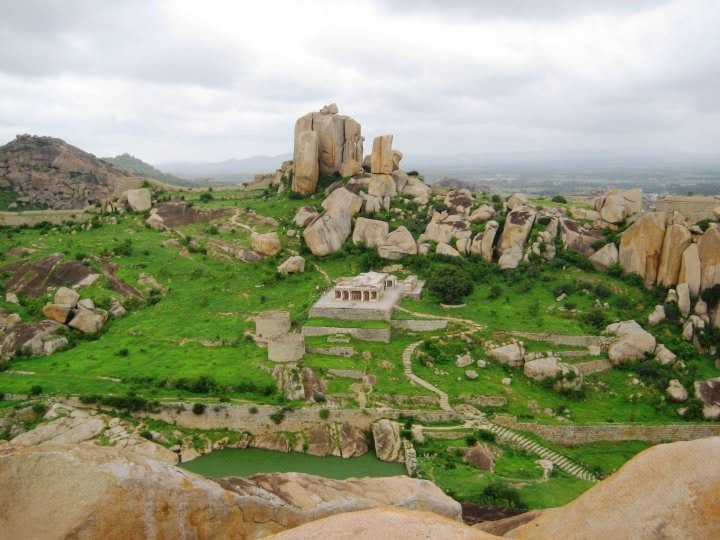

Visit Karnataka where heritage, nature, adventure, and culture converge to create unforgettable experiences